

Earth. NASA.1
The Earth is the only place in the universe that we know can sustain human life over the long term and the only place we know that life has evolved. It is beautiful, rich, diverse, and bountiful. The world feels enormous to most people. It is hard for many of us to take seriously the idea that humans—individually so small and insignificant—could be having a meaningful impact on the planet itself, and its ability to sustain the conditions needed for human life. In our ever-accelerating world, the changes are comparatively slow (in human terms) and can feel abstract, even as we experience record-breaking temperatures most years, see species migrating and landscapes changing dramatically over the course of a human lifetime. The overwhelming scientific consensus is that climate change is real, is largely the result of human activity, and constitutes a major threat to humanity that may be unmanageable. It is almost entirely vested interests that dispute this, and a similar scientific consensus also extends to the severity of most of the other threats.
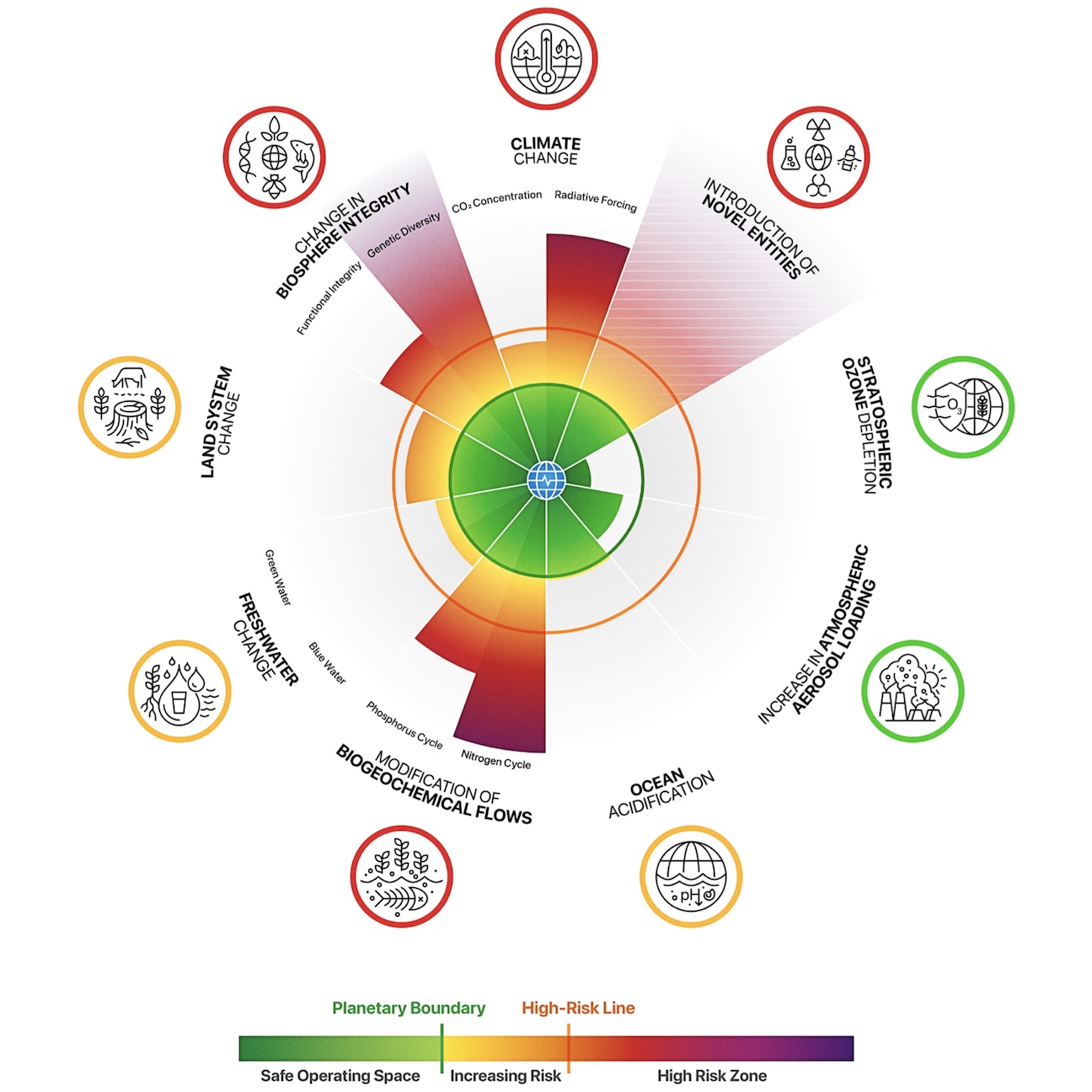
Rockström Planetary Boundaries, 2025.
Potsdam Institute for Climate Impact Research (PIK)2 CC-BY 4.0.
Johan Rockström and his team at the Stockholm Resilience Centre defined seven planetary boundaries in 2009, which they have since expanded to nine. These constitute an attempt to define a “safe operating space” for the Earth. The assessment is that if we stay within all of these planetary boundaries, the planet is likely to remain habitable for humans, but as we push the Earth beyond these limits, it becomes ever more likely that the processes and conditions that sustain human and other life will become less able—and eventually unable—to do so.
As you can see from the image, the nine boundaries cover and include things like climate, freshwater, oceans, stratospheric ozone, land systems, and the integrity of the biosphere. Each year the Potsdam Institute for Climate Impact Research assesses each of the nine dimensions and attempt to quantify where we are relative to them. In 2025, the best assessment is that we have already breached seven of the nine boundaries (ocean acidification only marginally) and four of the seven are assessed to be in the high-risk zone. The only success story so far is atmospheric ozone, for which the Montreal Protocol led to slow but clear recovery of the ozone layer, with the “hole” continuing to shrink.
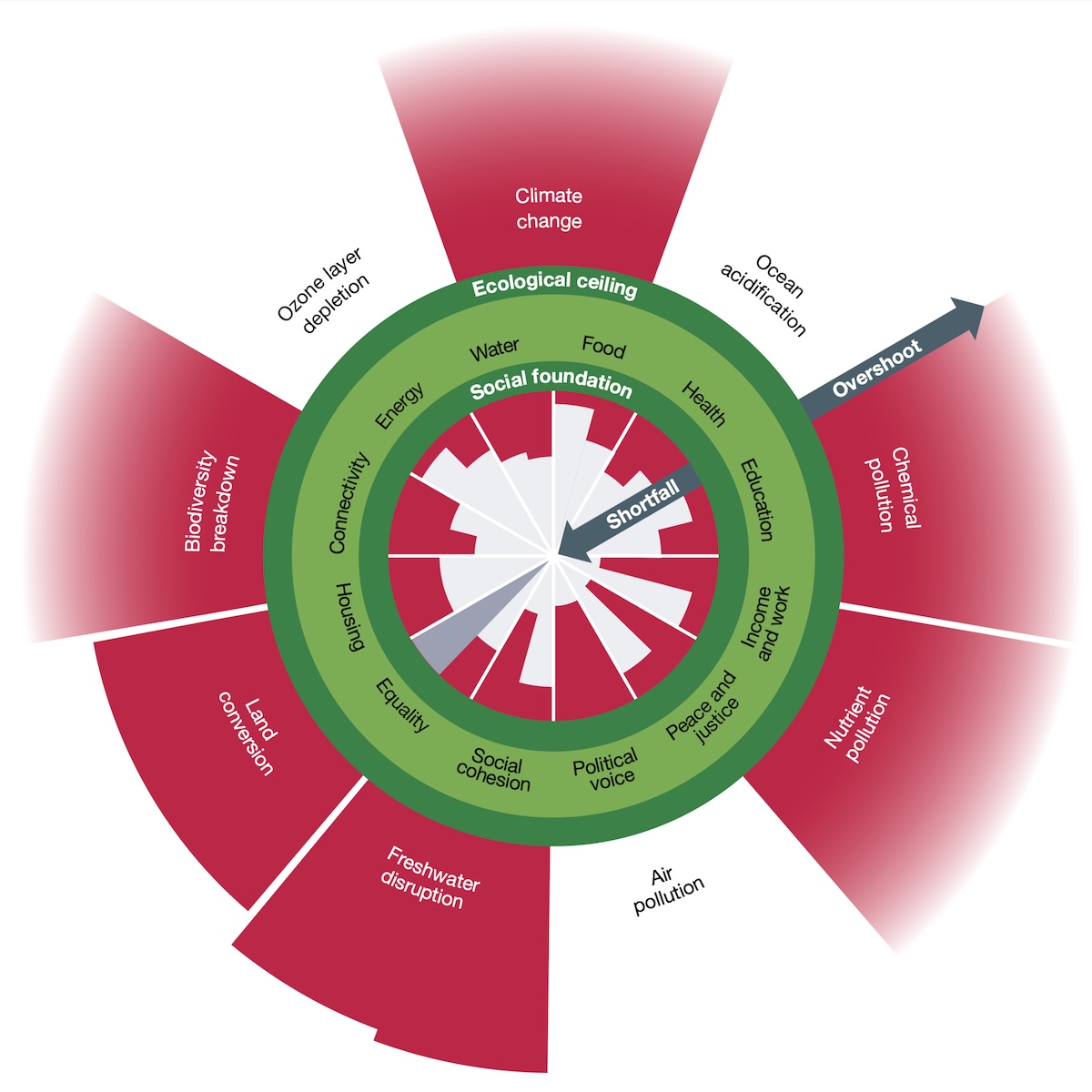
Kate Raworth’s Doughnut of Social and Planetary Boundaries.3 CC-BY-4.0.
Kate Raworth’s work on Doughnut Economics3 4 takes the Rockström boundaries and adds to them twelve social dimensions that quantify the essentials that everyone needs to lead a reasonable life. In the doughnut visualization, we see red segments in the middle showing estimates of the number of people who fall short in each of the dimensions around the globe. These are people without adequate access to things like water, food, healthcare, and education, as well as gender equality, political voice, and peace. The shortfalls on these not only cause direct human suffering (starvation, disease, drought, discrimination, lack of fulfillment) but also drive resource wars, dislocation and mass migration of peoples, and the increasing threat of novel global pandemics.
One of the themes of TDDA is multi-criterion decision making and non-commensurability. Non-commensurate variables quantify fundamentally different things and cannot meaningfully be traded off against each other, making the cost-benefit trick of “converting” non-equivalent measures to a common numeraire (invariably money) moot and misleading. The whole point of the nine planetary boundaries is that we need a livable climate and a healthy biosphere and healthy oceans and adequate clean freshwater and a functioning ozone layer and so forth. The same is true for social foundation. People manifestly need food and water and shelter literally to live, but also need education and human dignity and equality and access to healthcare to lead any kind of good life. A functioning ozone layer does not reduce the need for clean water, and adequate food does not reduce the need for a functioning, healthy biosphere. We all need all of these things.
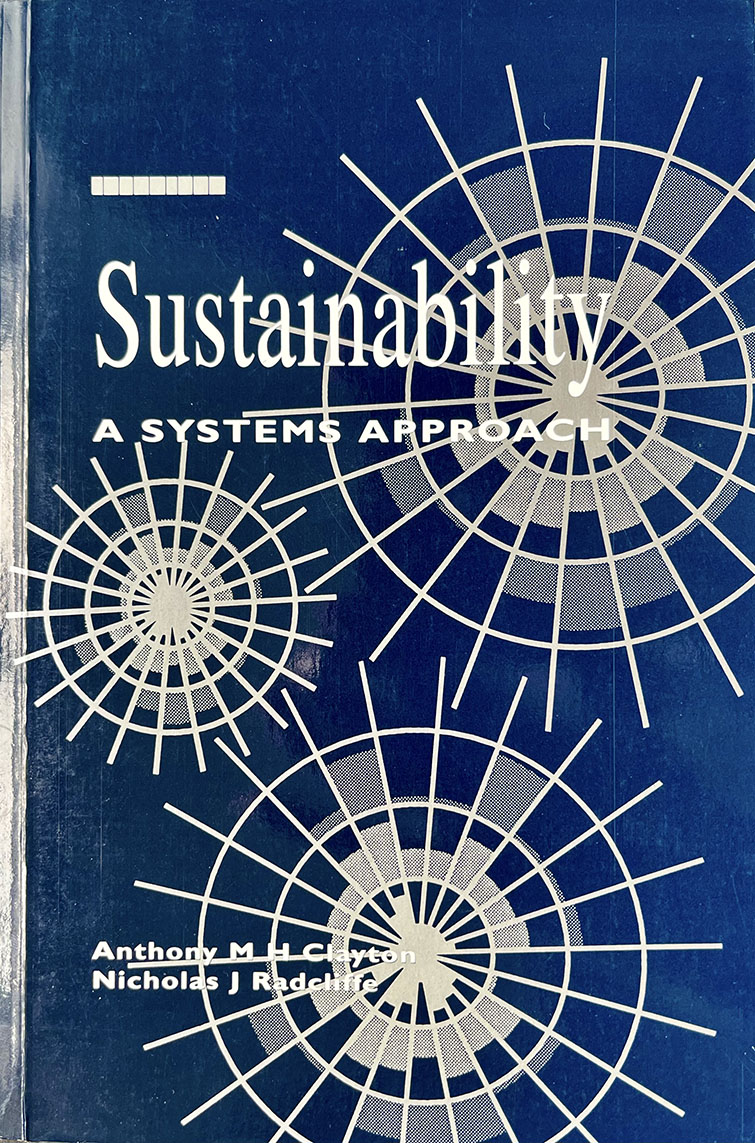
It is perhaps not a coincidence that Rockström and Raworth both landed on circular bar charts to illustrate our planetary and social boundaries and their breaches. This is the same format that Tony Clayton and Nick Radcliffe used in the 1996 book, Sustainability: a Systems Approach5 for WWF, which introduced “Sustainability Assessment Maps” (SAMs) and featured schematically on the cover. These are closely related to radar plots, and have the technical disadvantage of non-linear scaling but salient advantage of powerfully communicating non-commensurability, systems in the round, and systems thinking. Humanity needs to pull the Earth back towards and ultimately inside all of the planetary boundaries, and to lift whole populations currently below the social foundations up to the livable doughnut zone.
We tend to think linearly, even though non-linearity is all around us.
In linear systems, a 1% change in an input leads to a 1% change in the output. And in linear systems changes to multiple inputs combine additively, so that if a change in input A causes a 1% increase in output, and a change in input B causes a 2% increase in output, the effect of applying both changes will be a 3% change in output.
The whole basis of calculus is that at most points, most relationships are approximately linear for sufficiently small changes. But we are familiar with various salient ways in which systems, very much including natural systems, are non-linear, both in the sense of non-proportionality and of the presence of interactions between control variables.
At critical points, systems undergo phase transitions: ice melts as energy is added at 0°C, and water boils and evaporates as it is heated at 100°C. Beams and camels’ backs first deform and then break (fail catastrophically) under increasing load. Negative feedback loops inhibit change and keep systems in stable regimes for longer, but positive feedback loops accelerate change.
Ecosystems and other planetary systems teem with feedback loops of both kinds, and possess critical points and tipping points, known and unknown. As the permafrost melts, it releases trapped methane, a potent greenhouse gas, which drives warming of the atmosphere, which in turn melts more permafrost. Species become extinct, with knock-on effects throughout their ecosystem. We are losing species at a rate so high that it may rival the rate during the great extinction events. These losses include species we are unaware of, which play roles in ecosystems we have not begun to understand. Even regulatory feedback loops have limits; for example, the ocean will not forever continue absorbing the bulk of the carbon dioxide released into the atmosphere, as it currently does.
Critical points and feedback loops tend to make reversing changes hard, and in some cases practically impossible. We cannot really bring back extinct species, will not be able to recapture methane even if we regenerate permafrost, and as the sea ice melts, it is unlikely we will be able to recreate it. Many of these effects are ratchets, and when positive feedback loops kick in strongly, they can be all but impossible to reverse.
There are uncertainties in all areas, and it is possible that the safe operating space for the planet is larger than is currently estimated. But the scientific consensus is that we are gambling everyone’s future by pushing the Earth so far from the conditions that make modern human life possible.
If you are working to solve our multiple crises of sustainability, Stochastic Solutions will be an eager and committed partner.
Original image NASA Image and Video Library. ↩︎
Planetary Health Check 2025: A Scientific Assessment of the State of the Planet. Ed. Niklas Kitzmann, Levke Caesar, Boris Sakschewski and Johan Rockström. Potsdam Institute for Climate Impact Research (PIK). 2025 ↩︎
Doughnut of social and planetary boundaries monitors a world out of balance. Andrew L. Fanning and Kate Raworth. Nature, Volume 646, pp. 47–106. DOI DOI: 10.1038/s41586–025–09385–1 ↩︎
Doughnut Economics, Kate Raworth, Random House Business, 2018. Publisher page ↩︎
Sustainability: A Systems Approach. Anthony M H Clayton and Nicholas J. Radcliffe. Earthscan/Routledge. 1996. Publisher page ↩︎