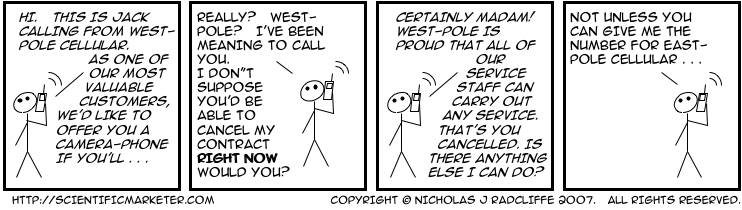

Hi.   This is Jack calling from West-Pole Cellular. As one of our most valuable customeres, we'd like to offer you a camera phone if you'll . . . Really?   West-Pole?   I've been meaning to call you. I don't suppose you'd be able to cancel my contract RIGHT NOW would you? Certainly Madam!   West-Pole is proud that all of our service staff can carry out any service.   That's you cancelled.   Is there anything else I can do? Not unless you can give me the number for East-Pole Cellular . . .

Targeting

2. Optimal Retention Strategies

Customer retention remains a top priority for most large consumer businesses. Yet the standard approaches to targeting customers "to be saved" often perform badly, with retention activity frequently back-firing for a minority of customers, and occasionally actually driving away more in total than it saves.

How can this be, and what can be done about it?

Driving Customers Away

Many companies engaged in retention activity have suspected or measured negative impacts for some segments of customers. Undesirable as they are, it's not hard to understand how these negative effects arise.

The typical state-of-the art approach to retention contains several key elements. First, the company will identify customers at risk of leaving. This will probably be based on a churn model (or an attrition model), which predicts how likely customers are to leave. In other cases, all customers coming to the end of a contract period or some other kind of "lock-in" will be assumed to be attrition risks. It would also be normal to take into account customer value, most commonly with some sort of historical measure, or sometimes with a projected value over some period. High-value customers judged to be at high risk of leaving are then targeted. The retention activity itself can take many forms, from a customer care phone call, perhaps with an offer, to some kind of mailing (paper or electronic), or a communication through a statement or the web. Alternatively, a customer may simply be flagged for special attention when he or she next contacts the company.

Though sometimes effective, there are number of problems with this approach.

  1. The first is that there is naturally a strong correlation between customers who are a risk of leaving and those who are dissatisfied with some aspect of the service they are receiving, whether it be quality, price, convenience, service or something else. Naturally, any form of intervention with such dissatisfied customers carries an intrinsically elevated level of risk.
  2. The second problem with intervention is that it provides a convenient, concrete opportunity for customers to leave who may have been too apathetic actually to do so of their own volition. We call this "triggered attrition".
  3. This likelihood of triggering customer defection is all the higher when intrusive contact mechanisms are used. Although it varies, for most people, a call is about the most intrusive, followed by direct mail, email and texts. In contrast, taking the opportunity of an inbound call from the customer to make an offer is relatively unintrusive and, if well targeted, is quite often seen as a positive by the customer. This is not to say that direct calling is always bad — simply, that it carries a higher risk of alienating the customer.
  4. Most importantly, the fact that a customer is at risk does not mean that any particular action we might consider is likely to save them. This is the fundamental problem with targeting customers in the standard way for retention activity. In effect, there is a built-in assumption that our intervention will have a beneficial impact, making the customer more likely to stay; sadly, most particular retention actions have negative impacts for at least some customers, and in a few cases those customers actually outnumber those for whom it is a positive.

A Better Way

Stochastic Solutions staff have world-leading experience in this customer retention modelling, and can help guide companies towards the most effective, modern approaches to retaining more customers. This includes evaluating the impact of past campaigns, where possible, designing new campaigns whose impact can be measured accurately if not, and preparing and helping the company through an evaluation and possible adoption of uplift modelling (incremental modelling) as a provably more effective, more profitable and usually cheaper way of increasing customer retention. The fundamental change is from targeting customers based on their probability of leaving, to targeting customers who can actually be saved.

This approach allows the customer base to be segmented in the ideal way, enabling companies to see which of their customers are likely to react positively to a given intervention, which are likely to be unaffected by it, and which are likely to be adversely affected, leading to increased attrition. This is illustrated below. Notice how, when there are negative effects, optimal targeting not allows only fewer people to be targeted, but actually saves more customers than does targeting everyone. In the illustration below, targeting 40% of the base actually saves 10% more customers than does targeting them all.

Gains chart for incremental saves from a retention campaign showing a region of positive net impact (net saves), a region of no net impact and a region of net negative impact (net losses)

It is also possible to extend this approach to the case where multiple treatments are available, and the problem becomes matching the best treatment to each customer.